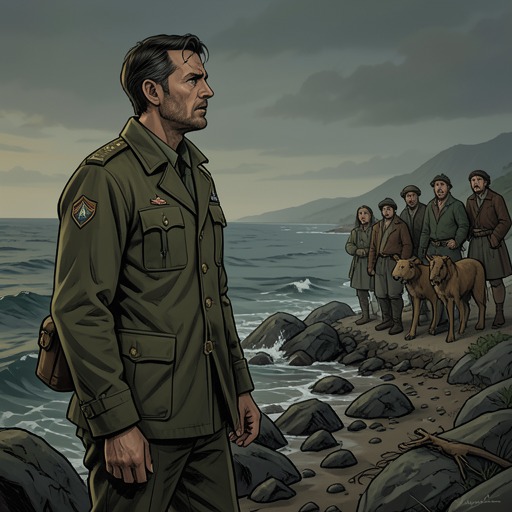
Leon Anawak–Greywolf
The SwarmLeon Anawak and Greywolf’s friendship is a relationship of long familiarity interrupted by estrangement and made explicit aboard the Independence. Its decisive moment comes when Anawak stops explaining Greywolf’s presence in terms of usefulness and admits that he wanted him there as a friend. Greywolf, in turn, interprets Anawak’s recurring iceberg dream not as a vision of departure into the Yrr’s world, but as evidence that Anawak is beginning to rejoin his own. Their bond gives Anawak a way to understand belonging not as heroic isolation, but as participation in the unruly company of the living.
A friendship aboard the Independence
The relationship develops amid the unusual routines of the voyage. The carrier’s flight deck has become a promenade and gathering place, where people walk, think, and debate beneath the waiting aircraft. In this setting, Anawak observes that Greywolf and Alicia Delaware are growing closer. Delaware gives Greywolf room, and he seeks her company; she now spends much of her time caring for the dolphins alongside him. Their public reserve does not conceal the change from Anawak, who recognizes the unmistakable signs of their growing bond.
Against this quiet shift in Greywolf’s life with Delaware, Anawak’s own friendship with him comes into focus. Anawak finds Greywolf sitting cross-legged at the bow, looking over the ocean and carving. The scene is reflective rather than operational: the two men turn from the work and debate surrounding them toward an object and the histories, dreams, and loyalties it brings into their conversation. Their closeness is not expressed through grand declarations at first. It takes shape in the attention they give one another and in Anawak’s willingness to offer Greywolf an intimate account of what has troubled him.
The bird spirit and the Nunavut dream
Anawak hands Greywolf a club and takes a bird spirit from inside his anorak, asking what Greywolf can tell him about it. Greywolf examines the object and says that it does not come from the west coast. The exchange makes Greywolf a confidant in Anawak’s effort to understand the bird spirit, but it also opens onto a more personal question: how Anawak has changed and what the dream he had in Nunavut might mean.
Anawak recounts the dream of an iceberg and says that he expected to sink into the sea. Crucially, the prospect of drowning did not frighten him; he expected to find life beneath the surface. He tells Greywolf that the dream has kept returning and that something changed while he was in Nunavut, although he cannot explain what happened. Greywolf listens intently before offering his interpretation. The dream matters to their relationship because Anawak does not present it as settled knowledge: he brings its uncertainty to a friend and allows that friend to answer.
From practical explanations to an honest admission
Greywolf asks Anawak why he and Licia were brought aboard. He rejects the easy practical explanation that his skill with dolphins is indispensable: the US Navy has other dolphin handlers, he says, while Licia has no particular role. Anawak calls her an excellent assistant, but Greywolf presses the distinction between being useful and being wanted. His question tests whether Anawak can name the personal reason for their presence instead of sheltering behind their work.
Anawak eventually answers plainly that Greywolf is there because he wanted him. When Greywolf asks why, Anawak says that they are his friends. The admission gives their bond a directness it had lacked in the conversation: Greywolf is not merely a specialist retained for the expedition, and the invitation is not reducible to the demands of the mission. Anawak’s choice to bring him aboard is itself evidence of attachment. Greywolf accepts the name of the relationship with a nod, allowing the exchange to settle into silence rather than turning it into a performance.
Estrangement, recognition, and belonging
Anawak explains how unusual the admission feels to him. He has generally got along with people, he says, but cannot remember having proper friends. He remembers that he and Greywolf once nearly came to blows: Greywolf was, in Anawak’s earlier view, twice his size and full of crackpot ideas. He also recalls an argumentative student who became his friend. The contrast shows that the bond has crossed through friction rather than depending on easy similarity. Anawak’s account treats their former clashes as part of the history they share, not as proof that friendship was impossible.
Greywolf answers by revising the story of their separation. The argumentative student, he says, did what friends do: took an interest in Anawak’s life. He suggests that the two of them had always been friends and that their heads had simply been closed for a while. The formulation does not deny the period of distance; it makes that distance temporary, something that obscured a relationship without erasing it. Greywolf’s response also meets Anawak’s uncertainty with sustained attention, the very quality he identifies as a friend’s action.
The living world, not the hero’s role
Greywolf turns the iceberg into an image of Anawak himself: an icy, unapproachable block, carrying his burdens while retreating inward. In Greywolf’s reading, the block has begun to melt. The ocean Anawak enters is not the kingdom of the Yrr but their world, and Anawak belongs there. Greywolf’s interpretation shifts the dream from a solitary descent toward an alien domain into a return to human relationships and ordinary, difficult life.
That life, as Greywolf describes it, includes friendship and love as well as hostility, hatred, and anger. Belonging does not promise calm or protect Anawak from conflict; it means accepting a place among the living, where relationships expose him to the full range of attachment and opposition. Greywolf also rejects the heroic role for him, observing that such roles were assigned long ago and are for dead men. The advice is relational as well as thematic: rather than retreating into an isolated identity, Anawak can remain present to friends and to the world they share. The exchange makes Greywolf more than a companion who confirms Anawak’s dream. He recognizes Anawak’s inward withdrawal, names their own bond, and offers friendship as a way back into life.